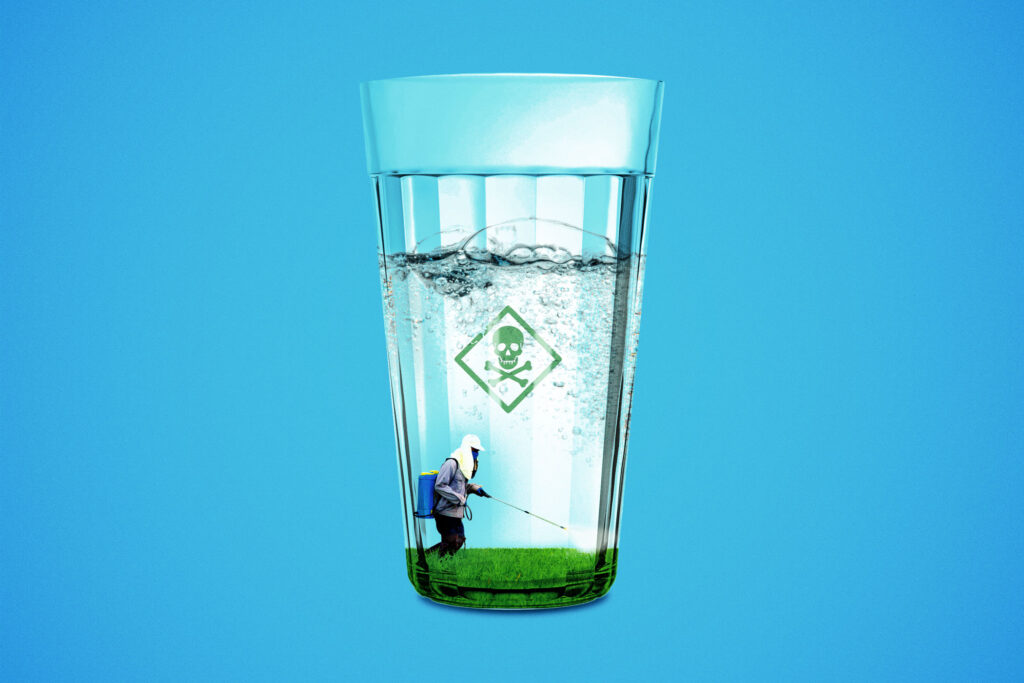

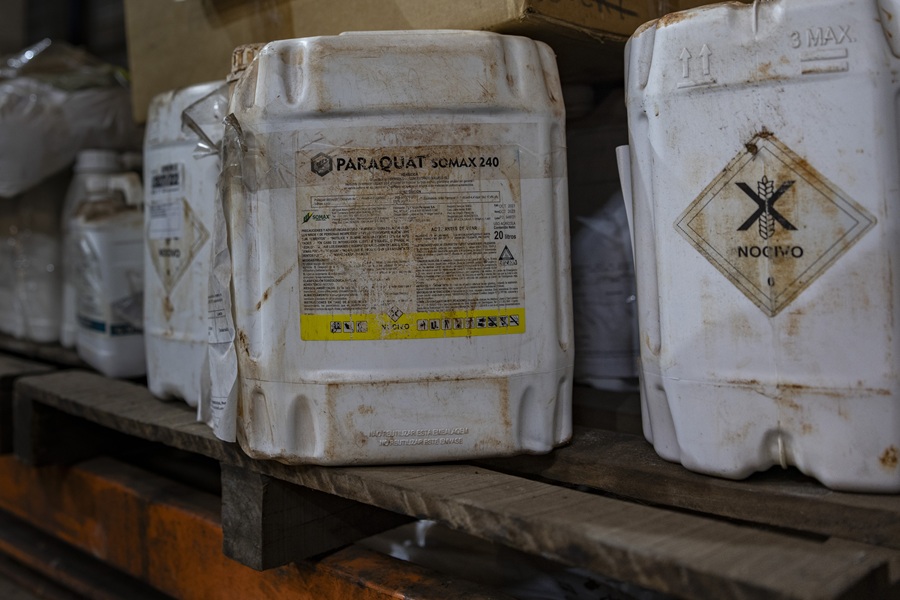
HERBICIDE banned in Brazil since 2020 because of its high toxicity, paraquat is the most smuggled pesticide into the country, according to information from the Federal Highway Police (PRF). The product enters Brazil through criminal networks operating out of Paraguay, Argentina, Uruguay and Bolivia, according to Brazilian authorities.
Experts interviewed by the journalists say the large volume of paraquat imported by Paraguay suggests that some of the product is actually destined for Brazil.
Between January 2025 and September 2026, neighboring Paraguay purchased 5,500 tonnes of the herbicide, equivalent to 0.718 kilograms per hectare of farmland, according to customs data. This proportion is six times higher than that recorded in the United States, whose agricultural area is 33 times larger than Paraguay’s.
Paraguay’s paraquat purchases had already tripled in 2023, after Brazil’s ban came fully into force, according to Senave (the National Service for Plant and Seed Quality and Health), Paraguay’s pesticide regulatory agency.
“There have been no drastic climate changes or massive expansion of planted areas that would justify a threefold increase in domestic demand in Paraguay,” says Luciano Barros, president of Idesf (the Institute for Economic and Social Development of Border Regions), an organization specializing in public policies in border areas, in an interview with Bloomberg.
CropLife Brasil, an association representing pesticide manufacturers, attributes the smuggling to differences between Brazilian regulations and those of neighboring countries, where paraquat remains authorized.
“There was no paraquat smuggling into Brazil. When Brazil became stricter through regulation, it ended up encouraging paraquat smuggling from Argentina, Uruguay and Paraguay into the country,” says Nilto Mendes, the association’s manager of efforts to combat illegal products.
CropLife’s director of chemical crop protection products, Arthur Gomes, argues that countries with major agricultural economies, such as Brazil, the United States, Australia and Japan, should adopt regulatory decisions that are “a little less conservative” than those in Europe, “without putting the population at risk.”
Anvisa (Brazil’s National Health Surveillance Agency) banned paraquat because of its toxicity, particularly to agricultural workers. In cases of poisoning, the herbicide can damage the kidneys, liver, gastrointestinal tract, cardiovascular system and lungs. In its assessment leading to the ban, the agency also linked occupational exposure to the development of Parkinson’s disease and identified the product’s mutagenic potential.
Before the ban, paraquat was among the ten best-selling pesticides in Brazil, according to Ibama (the Brazilian Institute of Environment and Renewable Natural Resources). The herbicide rapidly dries out leaves and was valued for leaving fields with a “clean” appearance.
The findings are part of an investigation tracing the routes through which banned pesticides enter Brazil, conducted through a partnership between Repórter Brasil, Bloomberg and Lighthouse Reports. Bloomberg compiled the international trade statistics. The consortium also identified five banned substances, including paraquat, in the water supplies of 790 Brazilian municipalities.
How paraquat enters Brazil
Will Soares* was about to turn 40 when he was doused in paraquat. Working as an operations assistant on a soybean farm in Goiás state, he was responsible for managing stock, recording production data and organizing field logistics. In late 2023, there were not enough workers to apply pesticides, so he was assigned to the task.
According to Will, the product was flown from Paraguay to a city in the interior of Goiás and then distributed to farms in the region by pickup trucks. The worker had never applied pesticides and had received no training. As he lifted a container to place it on a tractor, its seal broke and paraquat spilled over his body. The farm had provided him with only a mask as protective equipment.
The skin on his neck, hands, chest and feet turned red. He showered to remove the product and was dismissed for the day. The following day, he returned to applying paraquat and became ill in the field, experiencing nausea, vomiting and diarrhea. He was rushed to hospital, where he was diagnosed with acute pesticide poisoning.
During the period analyzed by Bloomberg, 98% of the paraquat imported by Paraguay — some of which also makes its way into Brazil, as in Soares’s case — came from China.
The Asian country accounted for 69% of the world’s paraquat trade. The use of paraquat on Chinese farms has been banned since 2016, but local authorities allow its manufacture for export.
According to the Federal Highway Police, Paraguay, Argentina, Uruguay and Bolivia are among the main entry points for pesticides banned or unauthorized in Brazil.
A master’s dissertation submitted to the University of São Paulo (USP) by geographer Karoline Araujo, examining seizures of banned pesticides in Mato Grosso do Sul, found that approximately 75% of the smuggled brands were likely of Chinese origin and nearly 15% were Paraguayan. According to the study, these products are manufactured in China, legally imported into Paraguay, where they are registered, and then smuggled into Brazil.
The database analyzed contains no records of paraquat seizures before 2021. The volume increased in 2022, after the deadline for using existing stocks in Brazil expired following Anvisa’s ban. For the researcher, smuggling is a possible “withdrawal symptom of chemical dependency”: when a widely used pesticide is banned, part of the demand shifts to the illegal market.
Data obtained by Repórter Brasil through Brazil’s Freedom of Information Law show that the Federal Highway Police carried out 336 operations to seize banned pesticides between 2023 and 2026, confiscating a total of 422.1 tonnes. The border states of Rio Grande do Sul, Mato Grosso do Sul and Paraná accounted for a large share of the operations. Mato Grosso do Sul, Mato Grosso and São Paulo were among the states with the largest volumes seized.
Pesticides have been part of border trade since at least the 1960s, explains sociologist Eric Cardin, from the “Borders, State and Social Relations” research laboratory at the State University of Western Paraná (Unioeste). Over the decades, the most sought-after goods and transportation methods have changed.
Smuggling often begins with small quantities carried on foot, by car, motorcycle or small boats, in a practice known as contrabando-formiga (literally, “ant smuggling”). “The people who make this initial contact are local workers, who are generally poorly paid,” Cardin says.
Larger-scale operators then collect the shipments and distribute them, mainly by truck, helicopter and airplane. This is why states far from the border, such as Bahia and Goiás, also appear in Federal Highway Police records.
According to the researcher, large distributors and criminal factions finance shipments and diversify their activities beyond cigarettes and fuel.
The products can enter Brazil in their original packaging or in concentrated form. In the latter case, they are diluted and repackaged in Brazil. This method can involve counterfeiting, making it difficult to identify the exact composition of the substances.
Unequal prices and regulations in Brazil and neighboring countries
Differences in prices and regulations between countries help explain the demand. In 2024, Brazil had banned 151 pesticides, compared with 20 in Paraguay, according to PAN International (Pesticide Action Network).
A pesticide sold in Brazil costs, on average, 50% to 70% more than in Paraguay, according to Cardin.
Experts say smuggled paraquat sells for approximately half the price of diquat, its legal substitute, which Syngenta began offering to customers after its predecessor was banned.
“The illegal market makes it possible to use molecules that are prohibited, that are more aggressive and that deliver faster results in the fields,” Cardin says.
The internet has opened up another sales channel. Repórter Brasil found agricultural supply stores advertising paraquat for sale online, as well as listings for the product on Facebook Marketplace. CropLife Brasil also recognizes social media and e-commerce platforms as channels for selling illegal products.
The association says it is developing a tool with technology companies to measure the availability of these products and provide information that would allow the Ministry of Justice to crack down on the trade.
It also argues that online sales should follow the same rules as physical stores, including requirements for invoices and registration, as well as bans on unauthorized products.
The size of the illegal market remains uncertain
Brazil is the world’s largest pesticide market. According to the Food and Agriculture Organization of the United Nations (FAO), the country used 755,000 tonnes in 2024, accounting for approximately one-fifth of global consumption. The United States ranked second, with 430,000 tonnes.
In 2025, Brazil also recorded the highest number of unintentional pesticide poisonings in 11 years: 9,729 reported cases, an average of 27 per day, as Repórter Brasil reported in March. The data do not make it possible to determine how many cases involved smuggled products.
There is no precise estimate of the size of the illegal trade. The Federal Highway Police says it has no study estimating the share of smuggled products in the market. “Even if the illegal market accounts for the most conservative estimate, we are still talking about a huge market for illegal products,” the institution says.
Estimates of the proportion of smuggled products in Brazil’s pesticide market vary considerably.
Idesf estimates that sales of illegal goods, including smuggled and counterfeit products, account for 24% of the total market.
The calculation was based on a study by Fiesp (the Federation of Industries of the State of São Paulo) covering the 2015/2016 harvest, which compared estimated demand with legal sales.
A 2021 study by Ipea (the Institute for Applied Economic Research) estimates that the illegal market is equivalent to 4.5% of the legal market. The research analyzed Federal Police seizures between 2008 and 2018.
“Regardless of whether it’s 4.5%, that’s a lot, and it involves all kinds of risks. These are products whose concentrations and contents we don’t know, and we don’t know whether they are counterfeit,” says Rodrigo Fracalossi de Moraes, a researcher at Ipea.
Industry calls for harmonized regulations across Mercosur countries
Idesf advocates joint action by Mercosur countries to “harmonize legislation,” since Brazil, Paraguay and Bolivia differ on which substances should be authorized.
According to CropLife, representatives of the association and Brazil’s Ministry of Agriculture and Livestock (Mapa) traveled to China in May this year to establish a cooperation agreement on the issue.
The association also offers training courses, in partnership with the University of São Paulo (USP) and the Ministry of Justice, on how to identify the illegal market. More than 8,000 police officers and inspectors have already taken part.
Repórter Brasil asked Mapa about joint initiatives with Chinese and Mercosur authorities but had received no response by the time of publication.
For Karoline Araujo, the industry uses its discourse against the illegal market to reinforce the idea that registered products are safe. “The more the industry is challenged, the more it reinforces its narrative about the risks of illegal products. But not necessarily because it is concerned about those risks — it is also losing a share of the market,” the geographer says.
CropLife says its campaigns warn farmers about the risks of buying uncontrolled products, arguing that the use of smuggled pesticides can finance organized crime, as well as cause environmental contamination and health problems.