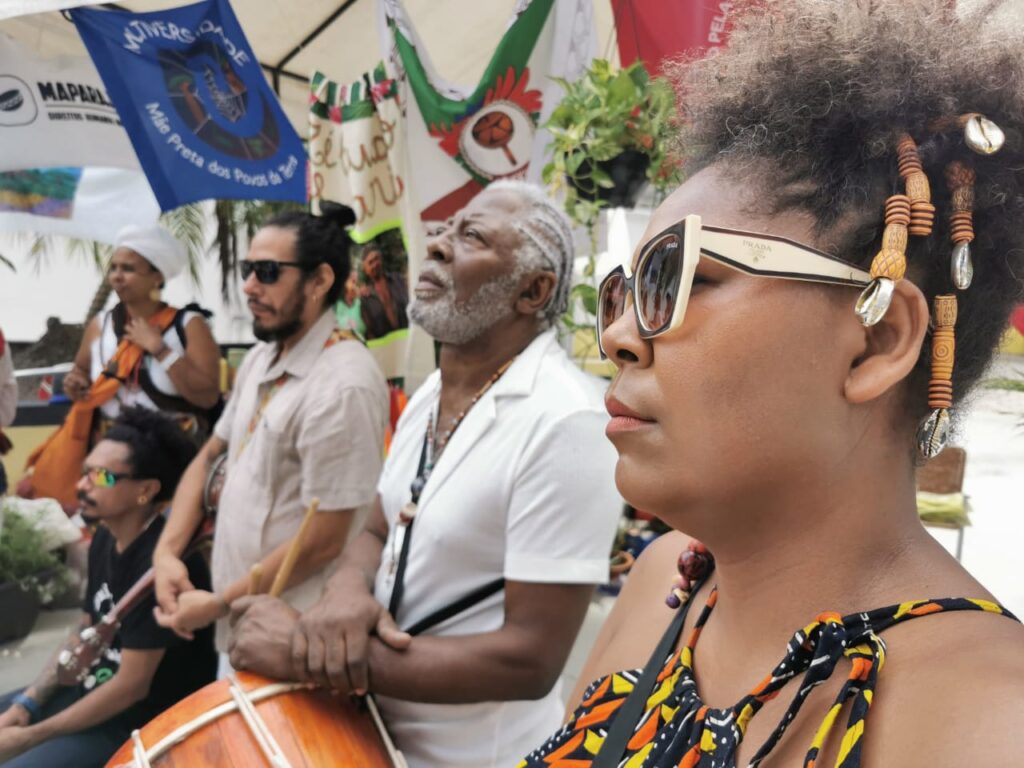


BELÉM (PA) – Indigenous groups and practitioners of Afro-Brazilian faiths entered the auditorium of the Federal Public Prosecutor’s Office in Pará’s capital, chanting, drumming and burning incense to prepare the space for the Peoples’ Tribunal against Ecogenocide, launched on Thursday (Nov. 13).
Running through Friday the 14th, the event is organized by the People’s COP, a grassroots movement that counters the official, government- and corporate-oriented COP30—the United Nations climate conference held in Belém until the 21st.
“This country would be worse off without your resistance,” said Felipe Palha, chief prosecutor for the MPF, as he welcomed the assembly. Indigenous leaders, nuns, Afro-Brazilian priestesses, and at-risk communities filled the hall to hear accounts of 21 cases of violations from around the world, with a focus on the Amazon
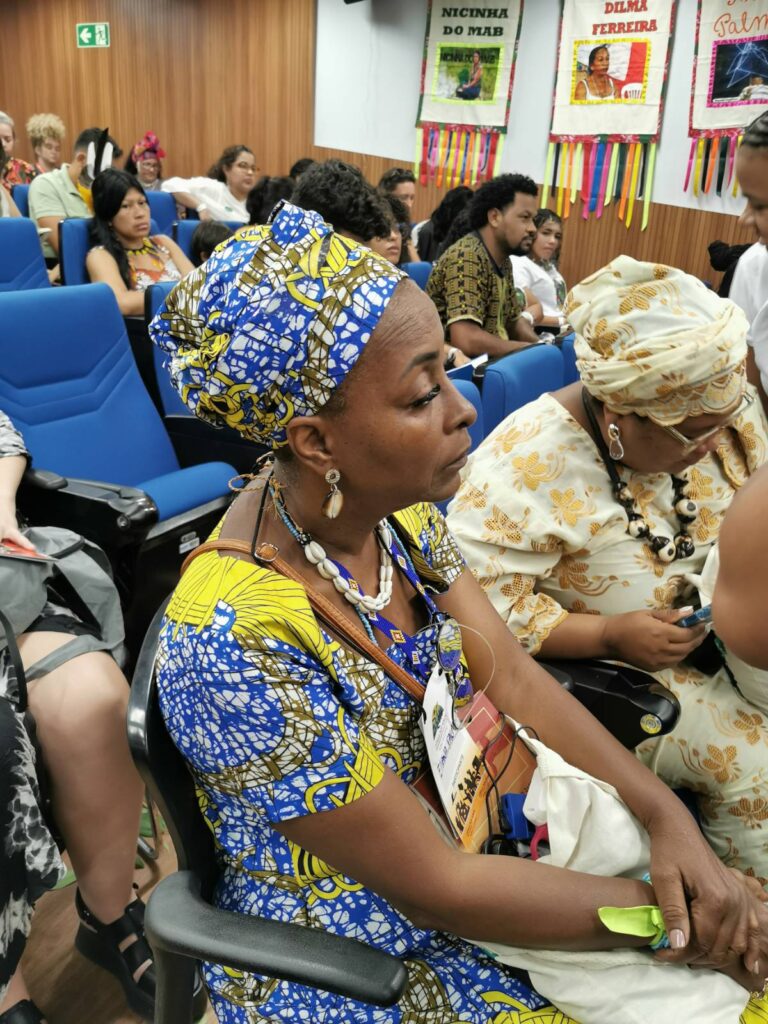
The cases involve land evictions, territorial disputes, environmental impacts, carbon credit contracts, river dredging, rural violence, and major development projects.
The tribunal, organized by 38 groups—including the Land Pastoral Commission and the Zé Cláudio e Maria Institute—serves as a symbolic and political forum. Here, affected communities testify about abuses before a panel of traditional leaders, scholars, jurists, and human rights organizations.
Afro-Brazzilian woman were afraid too travel to Belém
One case presented Thursday morning (Nov. 13) focused on the Quilombola Territory of Rosário, on Marajó Island in Pará. Tarcísio Feitosa of Forest & Finance recounted how community ancestors, Afro-Brazilians fleeing slavery on a plantation in the 18th century, marked the territory with four cement pillars. The land was registered at a notary’s office, and the deed remains preserved within a frame.
Feitosa described recent years of rice-farming expansion on Marajó. To control water, producers dug canals three to five kilometers long, about three meters wide and between three and four meters deep. These canals now block the community from hunting, fishing and fruit-gathering—such as for açaí—in traditional areas.
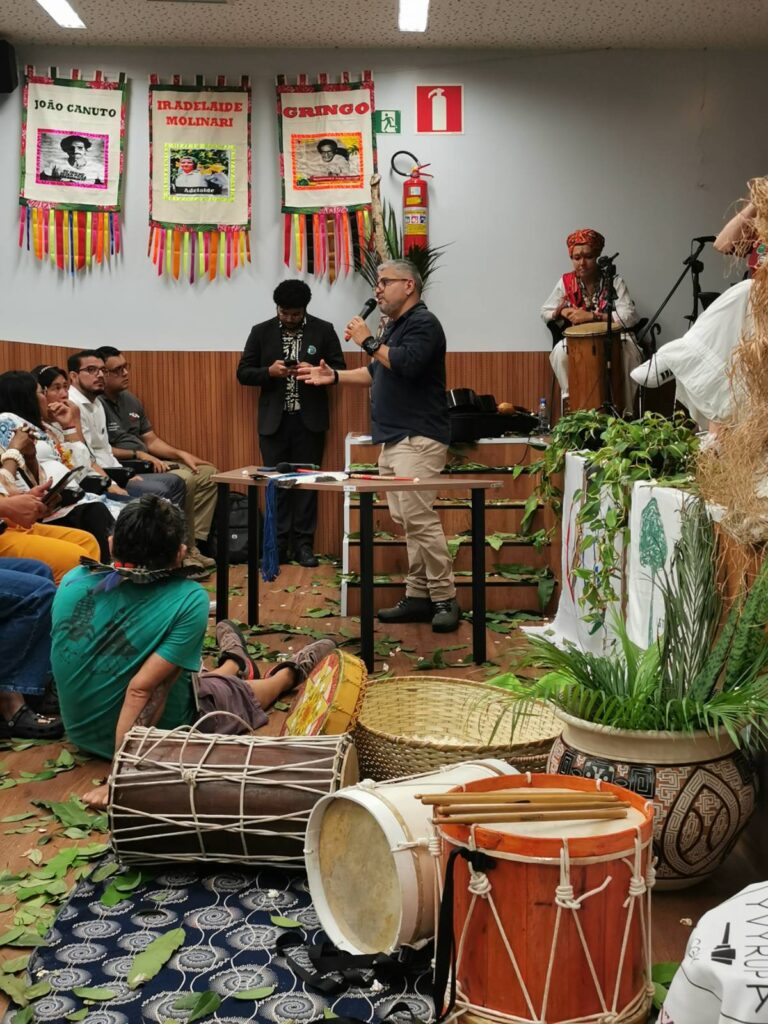
Two women from the community spoke out about the situation and received threats in return. Both were placed under the Program for the Protection of Human Rights Defenders. Initially planning to present their case before the tribunal, they told Feitosa just 24 hours ahead that they were too afraid to travel.
The Forest & Finance representative also cited environmental harm. According to him, the farm’s pesticide use is damaging local fish stocks. He reported that a natural lake behind quilombola lands disappeared after the new canals altered water flow.
Court ‘tries’ the murder of Fernando dos Santos Araújo, survivor of the Pau D’Arco massacre
Also at the tribunal, Luiz Felipe de Alencastro—historian and vice president of the Arns Commission—noted that these testimonies reveal recurring patterns in tropical and subtropical zones. He was particularly struck by a case from Bangladesh, whose representative faces persecution and was unable to attend.
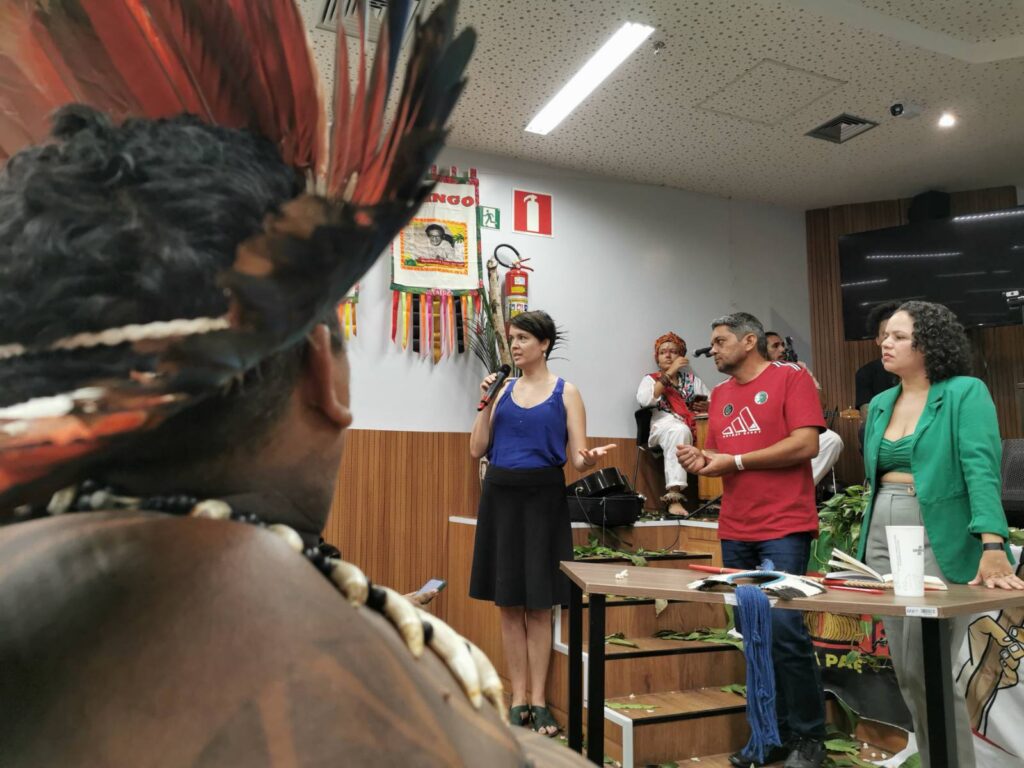
Alencastro also cited more than 300 communities in the Brazilian state of Maranhão that have been direct victims of poisoning from aerial pesticide spraying up until October 2025. Lawyer Diogo Cabral, who brought the case, described aerial spraying as “a deliberate war tactic” employed by the state’s large producers.
Alencastro also cited more than 300 communities in the Brazilian state of Maranhão that have been direct victims of poisoning from aerial pesticide spraying up until October 2025. Lawyer Diogo Cabral, who brought the case, described aerial spraying as “a deliberate war tactic” employed by the state’s large producers.
Another case was the murder of Fernando dos Santos Araújo, a survivor of the Pau D’Arco massacre, where ten landless workers were killed in a 2017 police raid on the Santa Lúcia farm in Pará. He was murdered four years later, and the crime remains unsolved.
Fernando was one of the central figures in the feature film “Pau d’Arco,” released this year by Repórter Brasil. Journalist Ana Aranha, who directed the documentary, testified about the case during the tribunal.
Cases still pending before the tribunal include violations related to the Belo Monte hydroelectric plant, carbon credit schemes in Portel (PA), dredging on the Tapajós River, and the effects of the Araguaia-Tocantins waterway.
Alan Francisco, coordinator of the Land Pastoral Commission in Pará, described the interfaith aspect of the tribunal—with its decorated space and the presence of the “encantados,” spiritual and mythical entities of the Amazon—as revolutionary. He observed that attendees saw themselves reflected in the cases. “Each case has its distinct elements, but they are united both by the violence they endure and by the way their communities organize to respond,” he said.