

AFTER DRAWING media attention for donating R$1 million (approximately USD 200,000) to Jair Bolsonaro’s 2022 presidential campaign, agribusinessman Oscar Luiz Cervi was cited following a June inspection by Brazil’s Ministry of Labor for keeping 35 workers in conditions analogous to slavery in the cotton fields of Fazenda Reata, in Campo Novo do Parecis, in the state of Mato Grosso.
Under Brazilian law, “conditions analogous to slavery” is a legal classification covering forced labor, exhausting working hours, degrading working or living conditions, and debt bondage or other restrictions on workers’ freedom of movement. According to the Ministry of Labor, inspectors identified both degrading conditions and restrictions on freedom of movement at Fazenda Reata.
Cervi, described as one of Brazil’s leading grain producers, supplies grain to Bunge, according to a corporate video released by the US multinational in March this year. In the video, Cervi says he has supplied the company for 42 years. He also says he planned to sell his entire cotton production to Bunge through Viterra, a Canadian multinational acquired by Bunge in 2025.
Bunge and Viterra supply raw materials to the biofuels industry and to manufacturers that produce for major fashion brands, including Lacoste, Levi’s and Gap.
Information obtained by Repórter Brasil also indicates that soy and cotton from Fazenda Reata were supplied to Bunge’s facility in the city Rondonópolis, Mato Grosso, one of the company’s largest industrial complexes in Brazil. Read more in the article: “Farm linked to slave labor holds sustainability certification and ties to luxury brands.”
Work at cotton fields without personal protective equipment
The slave labor case was uncovered on June 8 by MTE labor inspectors, with support from the Federal Police. According to information released by the ministry and reported by the Brazilian press, the rescued workers were manually removing weeds from the farm’s cotton fields without personal protective equipment.
Inspectors concluded that the workers had been subjected to degrading working and living conditions, as well as restrictions on their freedom of movement — two of the four elements that characterize conditions analogous to slavery under Brazilian law.
Labor inspectors issued an infraction notice against Cervi on July 15. He may appeal the citation at two administrative levels. If the Ministry of Labor confirms the allegations, Cervi could be added to Brazil’s so-called “Dirty List” of slave labor, an official federal government registry that publicly identifies individuals and companies held responsible for the practice.
Repórter Brasil contacted Cervi’s legal representatives for comment.
“We are confident that our procedures are compliant and reaffirm our commitment to following the law and the highest standards,” said a statement signed by Grupo Cervi, a company in which Oscar Cervi is a managing partner. “The relevant information and clarifications will be presented in due course,” the statement added, without addressing the specific questions raised by Repórter Brasil.
Bunge said in a statement that it had requested additional information from Cervi after learning of the “alleged subjection of workers to degrading conditions” at Fazenda Reata.
Bunge, which also responded on behalf of Viterra, emphasized that the property has been certified for more than three years by the Round Table on Responsible Soy (RTRS), one of the leading international certification standards for social and environmental practices in the soy industry. According to the company, the farm undergoes regular audits.
The company said it would continue monitoring the case. “Until the investigation has been concluded, Bunge will continue to follow the case with due diligence, reaffirming its commitment to respect for human rights, ethics, integrity and sustainability,” the company said. Read Bunge’s full statement here.
Worker housing under constant surveillance
According to the inspection, the workers were housed in containers measuring approximately 2.4 meters wide and 6 meters long. Each container accommodated nine people, resulting in overcrowded conditions.
The ministry said there were no toilets or designated eating areas at the worksites. Workers ate while sitting on the ground, in the shade cast by the bus that transported them to the cotton fields. Inspectors also found that the toilets near the containers were in poor hygienic and maintenance conditions.
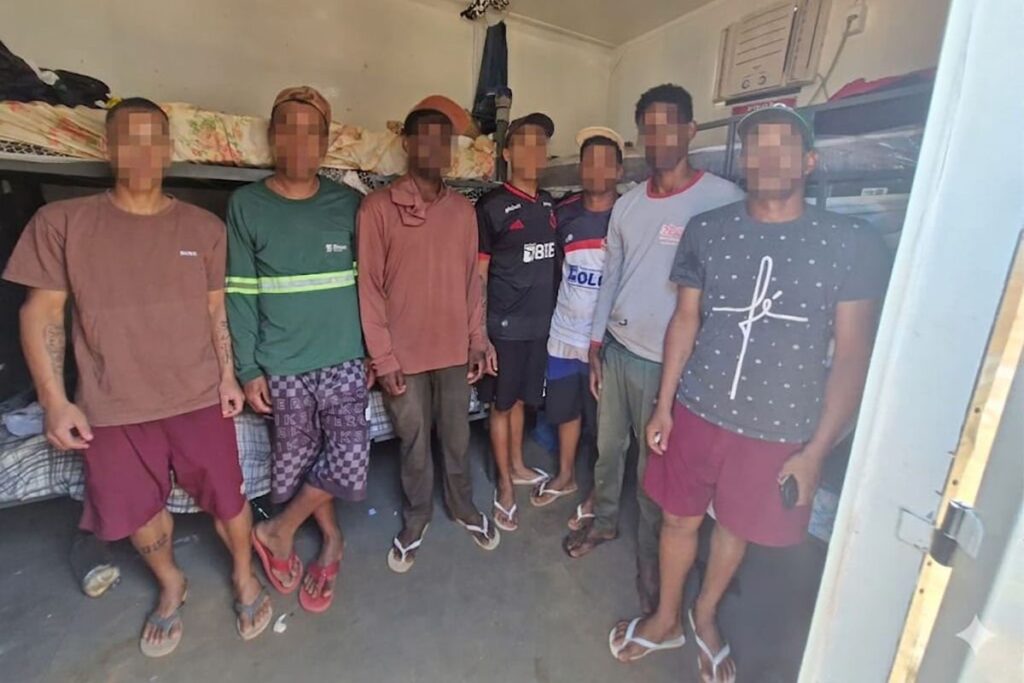
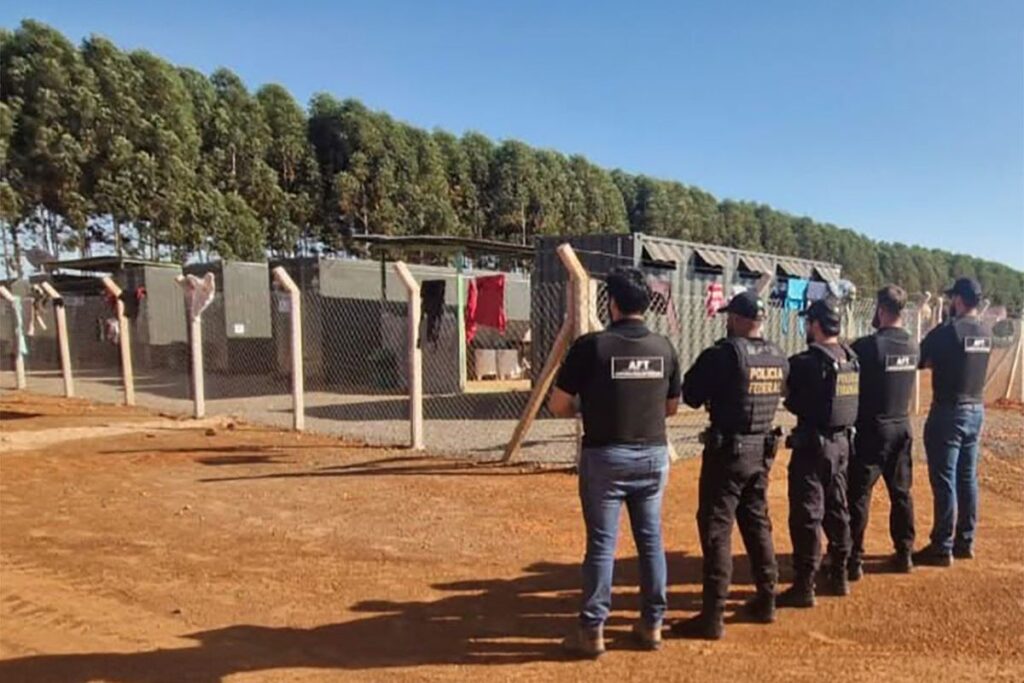
The housing facilities were located inside an area enclosed by metal fencing and barbed wire and were under constant surveillance, according to the inspection. Testimony collected by inspectors indicated that one of Fazenda Reata’s guards had been instructed not to allow the workers to leave the container compound.
The workers, who were recruited in the state of Minas Gerais, would only receive money for their return trip if they completed 45 days of work, according to the labor inspection.
Both circumstances indicated restrictions on the workers’ freedom of movement, concluded the inspection.
Inspectors also found that pesticides were being sprayed from aircraft over the same areas where the rescued workers were carrying out their activities and in locations near their accommodation. Labor inspectors assessed these forms of exposure as posing a serious risk to the workers. Some workers reported symptoms consistent with acute pesticide poisoning, including nausea, shortness of breath, irritation and burns to the skin.
According to the Minister of Labor, company representatives also allegedly took steps to obstruct inspectors’ access to the worksites, delaying the start of the labor inspection.
History of environmental violations
An analysis published by the news website The AgriBiz ranked Cervi among Brazil’s largest buyers of farmland in 2025, alongside major Brazilian agribusiness companies such as SLC Agrícola.
In addition to the labor violations identified at Fazenda Reata, Cervi has a history of environmental violations on other properties, according to the Mato Grosso State Public Prosecutor’s Office (MPMT).
In July 2025, state prosecutors filed a civil lawsuit against Cervi, Agropecuária Cervi Agro and other company representatives.
Prosecutors identified a deficit of 6,500 hectares of native vegetation in the Legal Reserve of Fazenda Santa Maria, in São Félix do Araguaia, in the state of Mato Grosso.
The deficit was identified after the MPMT analyzed information declared in the Rural Environmental Registry (CAR) for properties in the state. The electronic registry, which is mandatory for all rural properties in Brazil, is based on self-reported information.
According to the MPMT, the area, corresponding to 20% of the property, had been “illegally deforested” and “illegally exploited” for more than a decade.
Prosecutors estimated that using the farm’s Legal Reserve for soybean cultivation generated a total profit of R$91 million between 2005 and 2020.
In the lawsuit, the MPMT said the “enormous environmental liability” had been acknowledged by the defendants themselves before the Mato Grosso State Environmental Secretariat in September 2020. At the time, Cervi, the company and its other representatives signed a commitment agreement to compensate for the deforested area.
Prosecutors sought R$210.4 million in fines and damages from Cervi and the other defendants, as well as the suspension of activities in the area.
In November 2025, the defendants signed a legally binding settlement, known in Brazil as a Conduct Adjustment Agreement (TAC), with the Public Prosecutor’s Office.
They agreed to acquire at least 3,200 hectares of preserved native forest in the Amazon biome within the state of Mato Grosso and to refrain from carrying out any further deforestation on the property. The lawsuit was dismissed following the agreement.
Contacted by Repórter Brasil, Cervi and Grupo Cervi did not comment on the case.