

FROM CANAÃ DOS CARAJÁS, BRAZIL — The days drag for José Carlos Agarito Moreira, 48. Sitting in the yard of his small house, he spends most of his time with his feet up. “I just wait for it to get dark so I can go to bed,” he says. He tries to ignore the pain that cuts through his head and keeps him from working. At times, pus drains from the back of his neck and his ear.
“I think it’s the bullet corroding in there,” he says, pointing to the prosthetic eye he has worn since a military police officer shot him. With a parrot at his side, he watches the light traffic on his street in Canaã dos Carajás, in southeastern Pará, and hardly ever gets up. His routine changes only three times a week, when he leaves for dialysis.
Zé Carlos, as everyone calls him, was shot 30 years ago at the Curva do S, a bend in the road in Eldorado do Carajás, in the deadliest massacre in the recent history of rural Brazil. On April 17, 1996, military police, Brazil’s uniformed state forces, opened fire on members of the Landless Rural Workers’ Movement (MST) who were blocking the PA-150 highway to demand land reform.
Nineteen people were killed on the spot and dozens were wounded. Two more workers died of their gunshot wounds in the days that followed. In court, only the two commanders of the operation were convicted of homicide.
This week, as the 30th anniversary approaches, the MST is holding a five-day march from Curionópolis to Eldorado do Carajás, with political rallies, debates and cultural events along the way. It will end at the Curva do S with a ceremony honoring the victims and calling for land reform.
Zé Carlos was 18 at the time and had arrived only days earlier at the encampment on the Macaxeira estate where his parents were living. The family had migrated from the state of Maranhão to southeastern Pará when he was a child, drawn by the gold rush at Serra Pelada. The gold never came, and they ended up working on farms in the region with no land of their own.
Zé Carlos went to visit his parents and ended up staying. About 10 days later he was marching with the other workers along the highway toward Marabá, pressing the government of then-President Fernando Henrique Cardoso, of the Brazilian Social Democracy Party (PSDB), to expropriate the Macaxeira estate. Late in the afternoon of April 17, military police sealed off the road from both sides and moved in to break up the blockade.
At first he thought they were firing stun grenades. Then he saw a fellow worker go down. “They killed Amâncio first. Surdinho,” Zé Carlos says. Amâncio dos Santos Silva, nicknamed Surdinho because he was hard of hearing, walked toward the police without understanding what was happening and was shot.
That was when the workers realized the police were not simply trying to disperse them. They were firing live rounds. Zé Carlos tried to get out of the line of fire but couldn’t. “The cop aimed right at my face. At my forehead. Shooting to kill,” he recalls. The bullet went in through his right eye and he fell. “It doesn’t hurt at first. It’s so heavy that you fall.”
Wounded as he was, he got back on his feet with help from other workers and started walking, not yet grasping how bad the injury was. “This eye here isn’t mine anymore,” he says. The bullet stayed lodged in his head and was never removed.
Zé Carlos says he once received regular medical care under a court order, but the treatment was cut off. With help from a lawyer and the survivors’ association, he is trying to have it reinstated. “We’re working on getting it back,” he says.
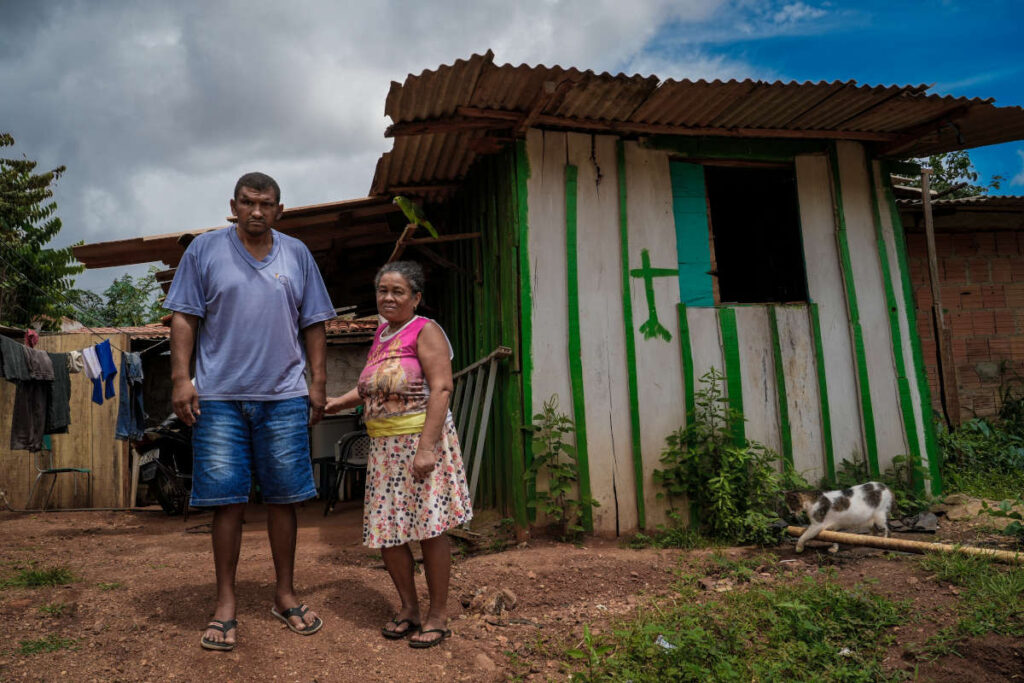
Zé Carlos is not alone, says Maurílio da Silva Soares, president of the massacre victims’ association. Dozens of survivors, he says, still live with serious lasting injuries and without regular access to the care guaranteed by court rulings and by agreements signed with the state of Pará since the late 1990s.
“The massacre never ended. It goes on in these people’s lives,” Soares says. According to the association, of the 69 workers wounded, at least 25 are still waiting for compensation and say they struggle to keep up with medical treatment.
Asked for comment, the Pará State Health Department (Sespa) said it is waiting for the survivors’ representatives to formally submit their requests so it can move ahead with the administrative process within SUS, Brazil’s public health system. Despite earlier requests, the department said, the required documents have yet to be submitted.
The department did not say how many survivors currently receive care or explain how their medical follow-up works.
“None of the survivors are getting medical care. Zé Carlos is the worst case. But they’re all waiting in line at SUS like everybody else,” Soares says. “In our case, it was the government that caused these injuries. So the government has to give us special attention. Our survivors are dying for lack of medical care.”
The Pará Attorney General’s Office (PGE) said the state is meeting the obligations it took on together with the federal government under the Inter-American human rights system. As for the court rulings, it said that “all have been complied with and settled.”
Pará leads the country in rural violence
Soares was also wounded in the massacre. Known in the movement as Márcio Lima, he adopted the alias in the early 1990s, during the MST’s first years of organizing in southeastern Pará, at a time of brutal violence in the countryside.
A survey based on data from the Pastoral Land Commission (CPT), a Catholic Church group that tracks rural conflict, found that Pará recorded 1,003 killings in the countryside between 1980 and 2024, more than any other Brazilian state. Nearly 75% of them took place in the south and southeast of the state. The figures appear in Assassinatos e Impunidade no Campo no Pará: 1980 a 2024 (Killings and Impunity in Rural Pará: 1980–2024), by José Batista Gonçalves Afonso and Airton dos Reis Pereira (Editora Dialética).
That pattern of violence intensified after the military dictatorship crushed the Araguaia Guerrilla, an insurgency organized by the Communist Party of Brazil (PCdoB) in the 1970s, and it came to shape relations among rural workers, large landowners and security forces across the region.
On the day of the massacre, Soares was hit by shrapnel and struck with a rifle butt that injured his left arm. Out of the MST leadership since 2002, he says he took over the association of maimed survivors to push harder for their rights.
Soares lives on a small property on the outskirts of Parauapebas, where he grows some vegetables and picks up odd jobs as a bricklayer’s helper. He no longer has the land he was granted after the massacre.
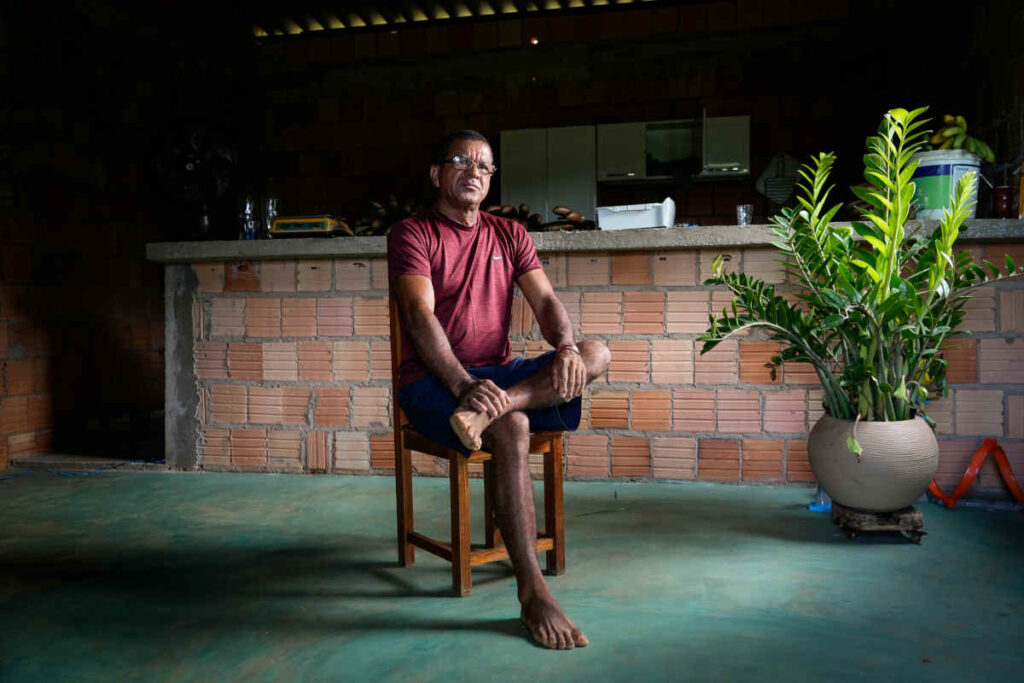
Maurílio Soares was one of the MST’s top leaders in Pará and now heads the association of victims of the Eldorado do Carajás massacre. (Photo: Fernando Martinho/Repórter Brasil)
“The survivors never stopped pressing for their rights,” says Poliana Soares, who sits on the national coordinating team of the MST’s human rights division. Over the years, she says, the survivors kept up the pressure themselves, and as the violations persisted, the movement once again gave them its direct support. Today that effort includes political lobbying, public hearings and pressure on the state to honor its obligations to the wounded, chiefly compensation and medical treatment.
In 1996, the MST and the Center for Justice and International Law (CEJIL) took the case to the Inter-American Commission on Human Rights, arguing that the Brazilian state was responsible for the deaths and injuries and had failed to properly investigate and punish the perpetrators. The commission declared the petition admissible in 2003. Thirty years on, the case is still pending, with no final decision.
Of the 144 police officers charged, 142 were acquitted. Only the commanders of the operation, Colonel Mário Colares Pantoja and Major José Maria Oliveira, were convicted of homicide.
The land he could not keep
Less than a year after the massacre, Zé Carlos was granted a plot in the 17 de Abril (April 17) settlement, created on the former Macaxeira estate. He spent about 20 years there, farming and raising his children. But the pain from the bullet kept getting worse. “Some days I couldn’t take it. Some days I’d black out,” he says. Unable to keep working, he sold his plot and moved to Eldorado do Carajás to seek medical treatment.
He started dialysis in Marabá, and every trip swallowed an entire day. He would leave before dawn and get back after dark, on the same highway where he had been shot. Later he sold his house in Eldorado as well and moved to Canaã dos Carajás, so he would not have to travel as far for treatment.
Today he and his wife live in a wooden house with one bedroom, a living room and a kitchen. His compensation is eaten up by loans he took out for medical bills, with the installments deducted at the source. He is left with about 500 reais a month and depends on his two children to put food on the table.
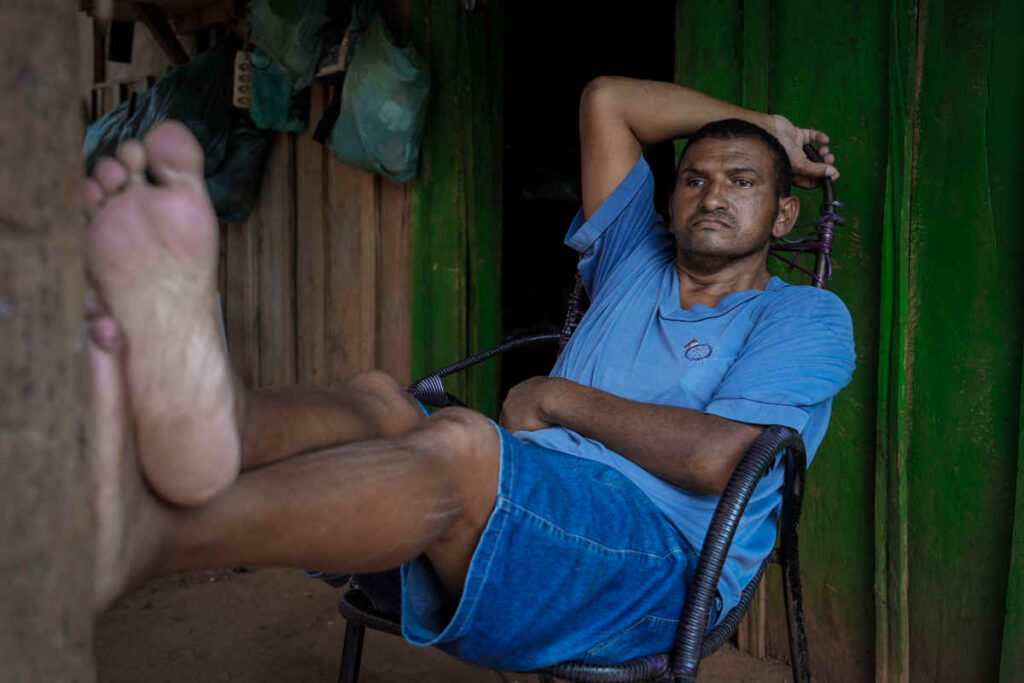
Even so, Zé Carlos says the fight for land was worth it. He remembers what he managed to grow on the settlement and what it meant to his family. “Land reform, to me, is struggle. It’s winning something. It’s so people like us can win a piece of land, work it and eat,” he says. “If it weren’t for land reform, you think we’d ever have had land? We wouldn’t.”
But he knows the violence, and what it left him with, changed everything. “Today I’m like this, with a bullet in my head. I can’t work.” He holds no grudge against the man who shot him. “If I ever ran into that cop, I’d have him over for a chicken dinner. At least he let me live.”
Unable to work and without the land he won, Zé Carlos spends his days sitting outside his house, waiting for night to fall so he can go to bed.
25 anos investigando para mudar.
A Repórter Brasil já ajudou a impulsionar leis, fortalecer direitos e combater o trabalho escravo.
Em 2026, fazemos 25 anos — e vem muito mais por aí!