

GLOBAL FINANCIAL INSTITUTIONS such as Swiss bank UBS (Union Bank of Switzerland) and the U.S. firms Morgan Stanley, Rockefeller Capital Management and Goldman Sachs have disclosed holding or managing shares in Brazil Potash, the Canadian company behind a mining project in Autazes, in Brazil’s Amazonas state, that is being challenged by Indigenous communities and Brazil’s Federal Prosecutor’s Office (MPF).
The data was reviewed by Repórter Brasil on market intelligence platform Fintel, which compiles information filed with the U.S. Securities and Exchange Commission (SEC). These records show equity stakes disclosed by banks and asset managers and may reflect both the institutions’ own investments and client assets under their management. According to data from February 2026, covering the last quarter of 2025, at least 28 financial institutions held or managed shares in Brazil Potash.
In Autazes, Brazil Potash hopes to secure this year the financing needed to build a potash extraction complex. Potash is a mineral used in fertilizer production. In addition to an underground mine, the project includes an industrial plant, an access road, power transmission lines and a port on the Madeira River. The company estimates initial output of up to 2.4 million tons per year, potentially supplying 20% of Brazil’s potash demand. Brazil is currently the world’s largest fertilizer importer.
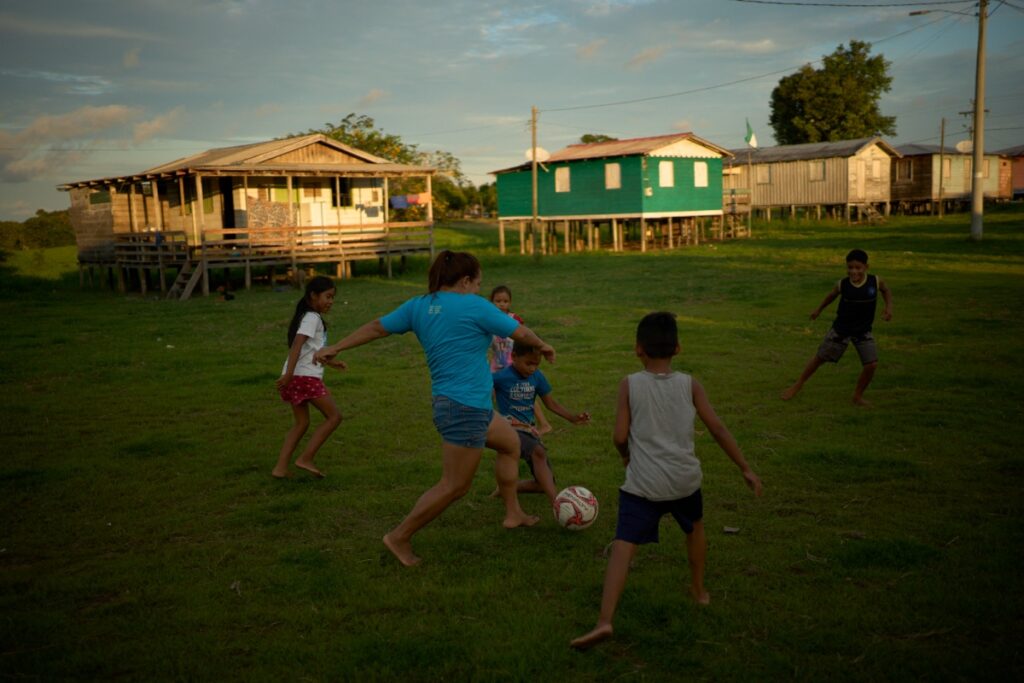
The entrance to the future Brazil Potash mine is about 2 kilometers from Soares village, an Indigenous Mura community. Since 2003, the Mura have been seeking formal recognition of the territory by Funai (Brazil’s National Foundation for Indigenous Peoples). Other Mura Indigenous lands that have been demarcated or are in the demarcation process — such as Jauary and Paracuhuba Indigenous Territories — lie less than 8 kilometers from the project area and could be affected by underground mining operations, according to the MPF.

Since 2016, federal prosecutors have filed lawsuits against Potássio do Brasil, Brazil Potash’s local subsidiary. The MPF questions the legality of the project’s environmental licensing and of the Free, Prior and Informed Consultation (FPIC) with Indigenous communities, as required under International Labour Organization Convention 169, which has been in force in Brazilian law since 2003. In October 2025, the Brazilian Federal Regional Court of the 1st Region (TRF-1) rejected appeals filed by the MPF, effectively clearing the way for construction to begin in Autazes. The MPF is appealing that ruling.
“If the companies hold shares in BrasilPotlash, they have a business relationship. By holding shares, they make the project/ business possible and also provide for legitimacy and reputation of the project/business,” said Julia Büsser, Amazon program manager at Voices, a Swiss organization that advocates for the rights of Indigenous peoples and minorities. In Büsser’s view, even if responsibility is not the same as legal liability and even without a majority control, “there is an obligation to use opportunities to exert influence. If influence is not possible, divestment must be considered as a last resort.”
Understanding the case
The race for potash in Autazes began in 2009, when Brazil’s federal government granted the first mineral exploration licenses to Potássio do Brasil. In 2010, the company began its first exploratory drilling in Autazes.
The dispute entered the courts in 2016, when the MPF filed a civil public action against Potássio do Brasil, Ipaam (the Amazonas State Institute for Environmental Protection), the National Department of Mineral Production (extinguished in 2017 and replaced by the National Mining Agency) and Funai. In the lawsuit, federal prosecutors say Potássio do Brasil began conducting studies in the area without consulting Mura communities.
The MPF also argues that because the project affects Indigenous communities, the authority responsible for environmental licensing should be Ibama — Brazil’s federal environmental agency — not the state agency. In 2017, the project’s licensing was suspended until consultation with the Mura communities potentially affected by the project was carried out.
The consultation process was marked by delays due to Covid-19, as well as accusations by the MPF and part of the Mura communities of “bad faith, harassment, psychological harm, moral damages, coercion, manipulation and intimidation against Mura Indigenous people” by Potássio do Brasil, according to a November 2023 ruling by the Federal Court in Amazonas that suspended the consultation process. The MPF also raised suspicions of bribery payments aimed at convincing Indigenous residents of Soares village to abandon their claim to formal land recognition.
The demarcation process for Soares and Urucurituba Indigenous Territory, which includes the area of Soares village, was opened by Funai in 2023 after two decades. The territory is currently listed as “under study” by the agency. This is the first stage in the formal recognition of an Indigenous territory in Brazil.

A year earlier, in 2022, the MPF had filed another civil public action seeking completion of the demarcation process for the Indigenous land. Funai, however, has yet to submit to the courts a timetable for completing the studies on Soares and Urucurituba Indigenous Territory, according to the latest case update, issued in January this year.
Despite the legal challenges, Potássio do Brasil obtained an environmental license from the state environmental agency, which was personally handed over by Amazonas Governor Wilson Lima in April 2024. A month later, the MPF filed a new lawsuit against the company, urgently seeking suspension of the license.
In that suit, prosecutors argue that the consultation process carried out by Potássio do Brasil with some Mura Indigenous people who approved the project did not include representatives from the MPF, Funai or members of Soares village, an as-yet-undemarcated territory that overlaps the project area. “Not even the Mura from the territory Potássio intends to drill in (the Soares Indigenous community) were present — in other words, it is as if they were negotiating other people’s assets, a pure fraud,” the lawsuit states.
According to prosecutor Fernando Merloto, who has followed the dispute between the Mura and Potássio do Brasil, despite the urgent request, the MPF’s case has not yet been ruled on.
When contacted, Potássio do Brasil did not respond to questions sent by Repórter Brasil by the time this article was published.
Project fuels internal tensions
During a visit to Soares village, the Mura community closest to the proposed mine site, Repórter Brasil spoke with tuxaua — a term meaning “leader” — Filipe Gabriel Mura. He said the project has deepened internal tensions and that families opposed to the mine report pressure and threats. He also described drilling and surveys on residents’ land, followed by pressure to sell plots to the company.
“They are violating our rights. They do not respect us as peoples who have cared for this land since we first came to these areas,” the Mura leader said.
Milena Mura, coordinator of the Organization of Indigenous Mura Women (OMIM), also criticized Potássio do Brasil’s consultation process, calling it “pro forma,” and denounced the exclusion of part of the community from decision-making. “The consultation was held only with tuxauas and commissions, and with the company present inside the territory, which the courts had already prohibited. Not everyone was heard,” she said.
Canadians in the Amazon
Brazil Potash Corp. has been listed on the New York Stock Exchange since 2024. Goldman Sachs, one of the world’s biggest investment banks, reported positions in 13,624 shares of the Canadian company during the period. Morgan Stanley, UBS and Rockefeller managed, respectively, 12,500, 9,941 and 6,500 shares. These institutions, however, are not Brazil Potash’s largest shareholders.
According to a document filed by Brazil Potash with the SEC in August 2025, the company’s main shareholders are two mining-focused investment firms: UK-based CD Capital, with 11.1 million shares (equivalent to 27.7% of Brazil Potash’s shares), and Sentient, registered in the Cayman Islands, with 7.3 million shares (18.3%). Canadian billionaire Stan Bharti, founder of merchant bank Forbes & Manhattan and former executive chairman and former director of Brazil Potash, holds 4 million shares, or 10% of the Canadian company.
Banks’ policies
In public documents reviewed by Repórter Brasil, the banks and asset managers say their business decisions must take human rights risks into account and that cases involving Indigenous peoples require special attention.
UBS, for example, says it does not do business when a transaction is associated with severe environmental or social harm, including violations of Indigenous rights, and that cases raising “concern” should trigger enhanced review and an internal approval process. According to documents from the Zurich-based bank, these guidelines apply to decisions involving product development, investments, financing and supply-chain management.
Morgan Stanley, in turn, states in public documents that potential human rights violations are assessed through its due diligence process — the process of identifying, preventing, mitigating and responding to human rights harms and environmental violations that a company may have caused or contributed to. The institution says it expects operations affecting Indigenous peoples to follow international standards, including proper consultation. The bank’s policy applies to transactions carried out directly by Morgan Stanley and by its suppliers.

Goldman Sachs’ policies also require a due diligence process before any business is carried out by the bank, including identifying possible violations of Indigenous rights.
Repórter Brasil reviewed the human rights and Indigenous rights policies of the financial institutions cited in this report and asked whether the Potássio do Brasil case violates any of those guidelines. None of the institutions responded by the time this article was completed. Repórter Brasil was unable to find contact information for Sentient. The companies remain welcome to comment in the future.
In response to the report, Stan Bharti, one of the founders of Brazil Potash, said the company “conducts its activities in Brazil with respect for the country’s institutions and regulatory framework.” He said the company carried out a Free, Prior and Informed Consultation process with representatives from dozens of Mura Indigenous communities in Autazes, and that the project received support from more than 90% of participants. “As with any major development initiative, differing views may exist within communities, and those perspectives remain part of an ongoing dialogue,” Bharti said. He also stressed that the consultation process, “as well as its validity and legitimacy,” was later reviewed and confirmed by TRF-1 in multiple court decisions.
“It would be much easier if the investors in Potássio do Brasil respected us. Because in the end it is disrespectful to our essence, our history, who we are and who we want to be,” said tuxaua Filipe Gabriel, from Soares village.
Supply agreement with Swiss trader
Beyond stock market dealings on the New York Stock Exchange, Brazil Potash has also advanced future potash sales agreements. Some of those investments come from Switzerland.
Swiss fertilizer company Keytrade signed a contract in August 2025 committing to buy up to 900,000 tons of potassium chloride annually from the Autazes mine over a 10-year period. The commercial agreement was signed between the Brazilian subsidiaries of the two companies. In 2022, Potássio do Brasil had announced a similar commitment with trading company Amaggi.
The Swiss Coalition for Corporate Justice warns that Switzerland may soon become the only country in Europe without binding legal due diligence requirements. According to the organization, the lack of regulation means sustainability commitments remain limited to voluntary initiatives, which often fail to produce concrete results.
In response to Repórter Brasil, Amaggi sent a statement it had released to the press in 2023, after signing its contracts with Potássio do Brasil. In the document, the company said the agreement with the mining company “provides for obligations on both parties to follow best environmental, social, sustainability and governance practices” and that all of its contracts are conducted based on “criteria guided by the socio-environmental commitments and policies adopted by the company and in accordance with applicable legislation and the rules of the competent environmental authorities.”
Repórter Brasil also contacted Keytrade, but the company did not respond to the questions sent before publication.
Project carries risk of water salinization
In the project’s Environmental Impact Study and Report, submitted in 2015, Potássio do Brasil acknowledges the risk that the project could salinize the water used by surrounding communities. The document points to the “possibility of water with a high salt content infiltrating shallow aquifers near the plant area, altering the quality of these waters.”
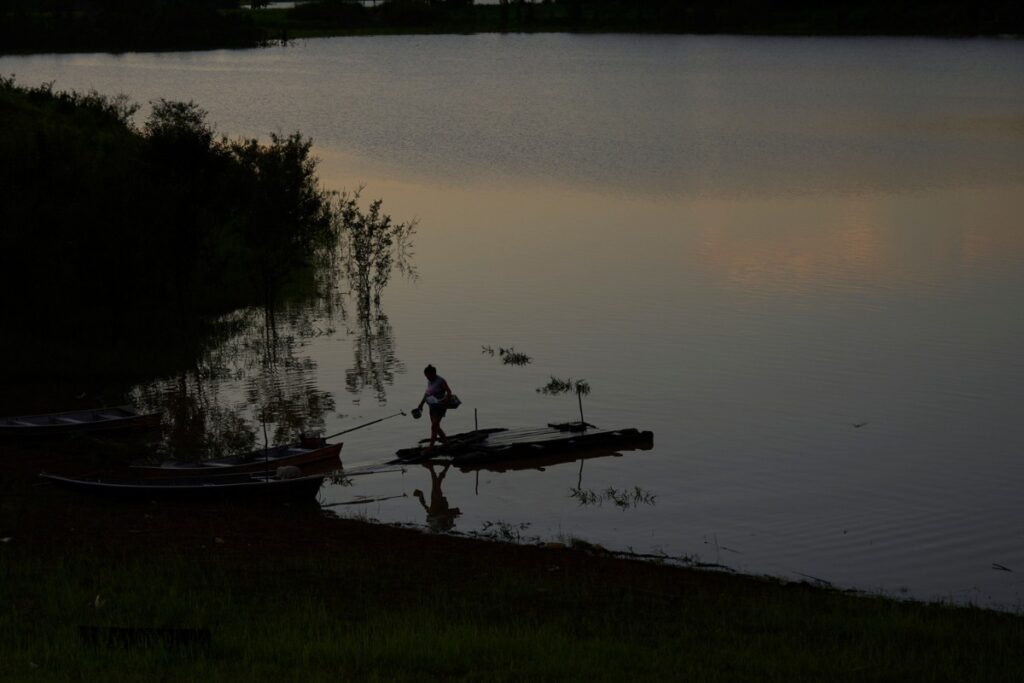
In the same document, Potássio do Brasil also acknowledges that deforestation and earthmoving may increase water turbidity and silt up drainage channels and rivers in the region, including Lake Soares, by leaving the soil exposed. The study says siltation could bury animals and reduce fish diversity, affecting subsistence fishing, a pillar of local food supply and the local economy.
Facing these threats, the tuxaua of Soares village fears the community where he was born could disappear once the mine begins operating. “[If the project goes ahead] there will be no way for anyone to keep living here. [This place] will become deserted, abandoned houses,” Gabriel Mura told Repórter Brasil.